Tuesday, July 13, 2010

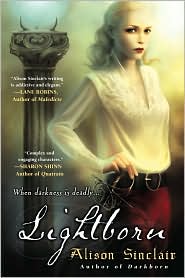
Lightborn
Book #2 of the Darkborn Trilogy
by Alison Sinclair

Lightborn is the second book in the Darkborn Trilogy by Alison Sinclair.  The final volume, Shadowborn, is scheduled to be released in 2011.  The first volume is Darkborn, and was recently reviewed by me.

In this installment, Sinclair expands the reader’s view of her unique world by introducing three Lightborn characters (the previous book followed three Darkborn characters.  For more information on the world, please see my review of Darkborn).  We had already met Floria White Hand briefly in the previous book, and now she becomes a main character.  We follow her into the ruling court of the Lightborn, where she introduces us to Fejelis, son and heir to the prince, and the rebellious mage Magister Tammorn.  Darkborn Lady Telmaine also returns to keep us abreast of developments on the other side of sunset.  The other two main characters from Darkborn, Dr. Balthasar Hearne and Baron Ishmael di Studier do not appear in this book, being offstage preparing for the third book.  I’m sure when we see them again, they will be chock full of useful information.

Floria White Hand is a valued and trusted guard and food taster for the Lightborn prince, and when he is assassinated in a bizarre fashion, she becomes a suspect.  Being unable to prove her innocence, and having far too many political enemies, she claims asylum from the Darkborn.  Before leaving, however, she gives Fejelis the advice of hiring Magister Tammorn to investigate his father’s death because Tammorn is as far removed from mage politics as it is possible to get.  Fejelis and Tammorn work on finding out who killed Prince Isidore while keeping Fejelis alive through another round of attempted assassinations.

Meanwhile, Lady Telmaine is in the Darkborn court trying to master her neglected magical skills enough to keep the Archduke and his brother, the spymaster, alive.  More assassination attempts here, and yes, all these people trying to kill other people are in fact connected.  In any case, things do not go well for Telmaine (this being the second book of three, nothing should go right).  However, all the important people survive and get enough clues to move on to the showdown in book three.

If you are still under the misconception that these books are fantasy romances, I shall further disabuse you of the notion here.  There is not a single romantic line in this book, unlike the hint of one in the earlier book.  Lots of action, lots of politics, lots of intrigue, and of course, lots of fantasy.

My only complaint about this book is that the Lightborn court is really glossed over.  We’ve had an entire book to figure out how the Darkborn politics and society work, but the Lightborn do not get equal billing.  Part of this is that they are, by force, more familiar to us because they have the same set of senses we do.  However, there’s a lot of socio-economical and geo-political stress in this society, and we get barely a taste of it and how it all came to be.  The need for space to explain all of the action has taken precedence over world building, and while the book works well, I’d still like some more background.

Lightborn is available in trade paperback, and e-book editions.  I would recommend this book to fans of Sharon Shinn, Mercedes Lackey, Gregory Frost, and N. K. Jemisin.

Tuesday, July 6, 2010

Review: Darkborn

Darkborn
Book #1 of the Darkborn Trilogy
by Alison Sinclair

Darkborn is the fantasy debut of Alison Sinclair, though she has previously published several science fiction novels.  Darkborn is also the first book in a trilogy, the second of which, Lightborn, was recently released and the third of which, Shadowborn, is scheduled to be released in 2011.

Intrinsic to the book is its world building: eight hundred years ago, a particularly strong mage named Imogene and her accomplices cursed all of humanity.  Half of them would become the Lightborn, who gained enhanced eyesight, but for whom shadow was lethal.  The other half became the Darkborn.  They gained the ability to generate sonar (called sonn) along the lines of what bats use, and for whom light is lethal.  They are also completely blind, having no further need for their eyes.  For the most part, except in the capitol city, the Lightborn and the Darkborn live completely separated, as their living conditions are lethal to each other.  In the capitol city, they use many of the same streets and other infrastructure, alternating with sunrise and sunset. 

This first book follows three Darkborn characters, Lady Telmaine Stott Hearne, her husband Dr. Balthasar Hearne, and the Baron Ishmael di Studier.  When the book opens, Lady Telmaine is at a society function in the country with her family, at which she meets Baron di Studier for the first time.  At the behest of one of Telmaine’s cousins, he escorts her and her two daughters back to the city, where they find Dr. Hearne under attack by thugs, who then seize the opportunity to kidnap the elder Hearne girl.  It turns out that a few days previous, Balthasar helped a society lady bear illegitimate twins in secret.  These twins, however, were obviously strange, and the thugs want the two babies, who have already been sent to fosterage.  The rest of the book follows the Hearnes and di Studier as they try and figure out why these babies are important and get the Hearnes’ daughter back.

Darkborn has for some reason has been slipped into the paranormal romance subgenre, which I think is another fine example of marketing gone awry.  Telmaine is fiercely attached to her husband, though she and di Studier clearly develop some feelings for each other.  There is not, however, any hint of courtship or the idea that Telmaine might either have an affair or outright leave her husband.  Instead, this is an action adventure with political intrigue thrown up on a heroic journey frame.  Honestly, I like it better for it not being a romance.

Darkborn is well written, and by the end of the first quarter of the book I was fairly comfortable with the idea that all of the characters were blind and were using other senses to interact with each other and their surroundings.  It’s very deftly handled, right down to figures of speech: darkborn never say that they ‘see’ anything, because they can’t.  They never say ‘I see’ when they mean ‘I understand.’  The culture, and the various levels of society and how they speak and interact are also well developed.  I have read other reviews that complained that there could have been more world building and an expansion of the politics involved in the plot.  I can agree that there is a lot of room for expansion, as there are times when the plot has more slam/bang action than perhaps was necessary, however I don’t feel that there are any gaping holes that Sinclair forgot to fill.  This is a relatively short book, at 352 pages (well, short for a fantasy novel), especially considering how complicated the plot is.  So yes, she could have added another 100 pages to flesh things out, but overall those pages weren’t strictly necessary, and would have been detrimental in the subgenre it was marketed for.

Darkborn is available in trade paperback, mass market paperback, and e-book editions.  I would recommend this book to fans of Sharon Shinn, Mercedes Lackey, Gregory Frost, and N. K. Jemisin.

Thursday, June 3, 2010

So, a look at things I’m interested in that are being released this month.  Obviously, I’m not going to make it to all of these.  After the day-job, the writing-not-job-yet, housework (ugh, but it has to be done!) and social time, my reading time is not what it used to be.  I also have seven books on hold from the library, which will then come in an avalanche (because processing hates me and does everything at once) and bury me.  Plus the books I’ve already checked out.  So, this is essentially a look at things I think might be nifty.

Lightborn, by Alison Sinclair, is the second book in her paranormal-regency-romance was just released.  I haven’t read the first one yet (as we just got it in at the library), but I find the concept intriguing, as well as the favorable reviews it’s garnished for having a convoluted plot.

Nomansland is Lesley Hauge’s debut.  This seems to be a post-apocalyptic dystopian novel featuring Amazons.  As it’s been awhile since I read something post-apocalyptic, I’m game.

Bullet, the nineteenth book in Laurel K Hamilton’s Anita Blake series is out this month.  I will confess, I won’t be reading it.  But this is noteworthy as one of the original paranormal fantasy series, and I believe the longest running one.

Mercedes Lackey starts off a string of releases over the next six months with The Sleeping Beauty, installment number five in the Five Hundred Kingdom’s Series.  I don’t expect this to be a great book, but a fun and enjoyable romp.  My friend Hanna calls books like these potato chips: not all that good, not good for you, but enjoyable and a welcome break from heavier material.

Meg Cabot has made a move into the chick-lit vampire market with Insatiable.  First, I’m amused that someone like Cabot would move into that market as she already has a huge fan base in straight chick-lit.  Second, I’m intrigued as this is supposed to be more than a little tongue and cheek.


;;